

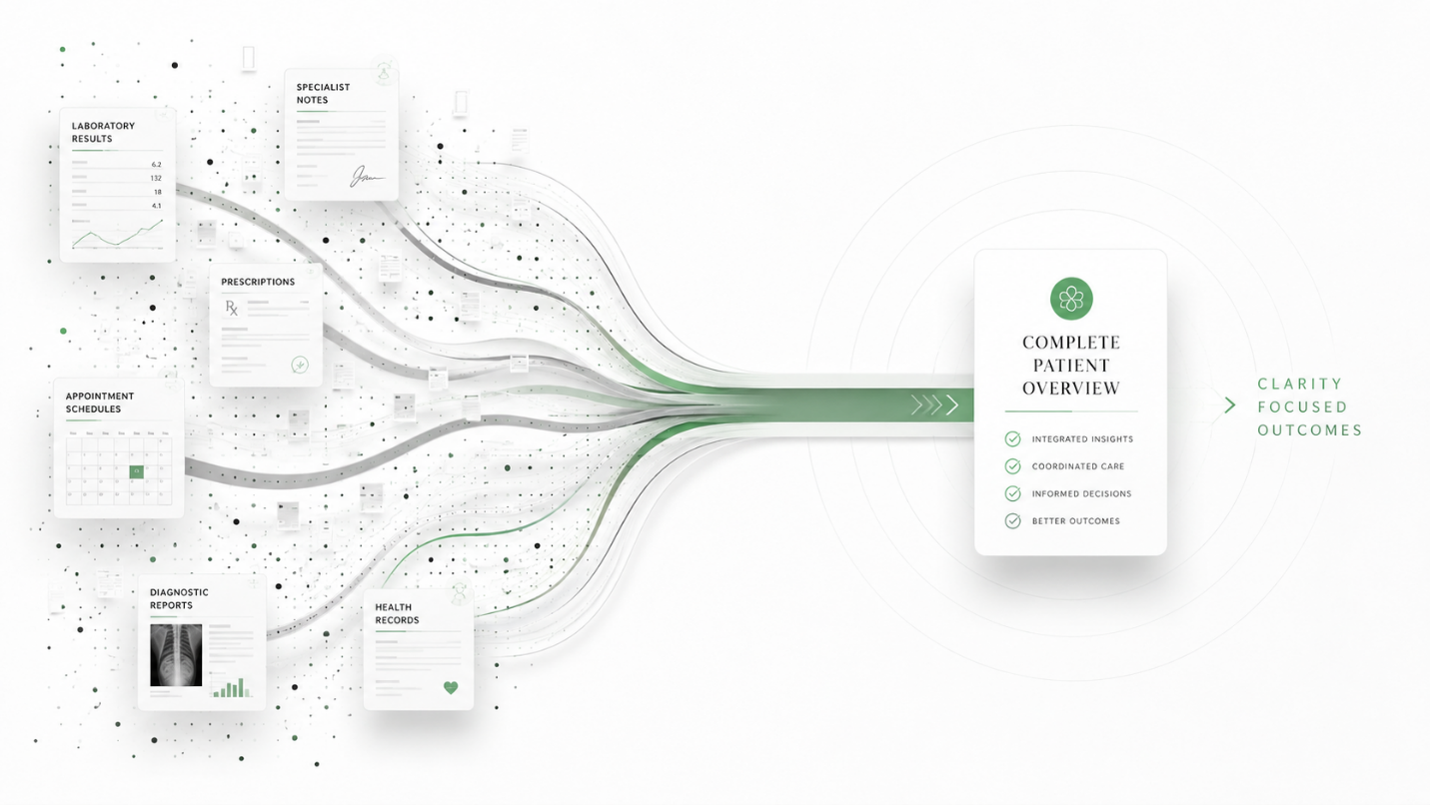
The Problem Isn’t Your Health. It’s Navigating Healthcare.
Spend enough time around patients and you begin to notice a pattern. Many people become frustrated with healthcare long before they become frustrated with their health.
The frustration rarely stems from a lack of medical expertise. Most patients respect their physicians and appreciate the remarkable advances modern medicine has made possible. If anything, today’s healthcare system is more capable than ever. Specialists possess deep expertise. Diagnostic tools can detect problems earlier and more accurately. Treatments are increasingly precise and personalized. Few patients would willingly trade those advances for the medicine of previous generations.
Ironically, some of the frustrations patients experience today arise because healthcare has become more capable, not less.
Consider Hannah, a 52-year-old executive who initially sought medical attention for recurring fatigue and intermittent chest discomfort. Over the next six months, she consulted a family physician, a cardiologist, an endocrinologist, and a gastroenterologist. None of the consultations were wasted. Each specialist brought valuable expertise and uncovered information that deserved attention. Yet as the process unfolded, Hannah found herself spending almost as much energy managing her healthcare as receiving it.
She kept track of laboratory results from different providers, maintained a growing collection of reports and prescriptions, coordinated follow-up appointments, and repeatedly explained the same medical history. One appointment required a long drive across the city for a consultation that lasted less than fifteen minutes. Another generated a referral that led to further testing and yet another appointment. By the time she had answers to some questions, new questions had emerged.
What frustrated Hannah was not the quality of care. It was the effort required to connect the care.
Many patients know exactly what she means. People often think of healthcare as something they receive. Increasingly, it is something they are expected to manage. After a few months, conversations that begin with symptoms often shift toward logistics. Patients talk about appointment schedules, patient portals, insurance approvals, medication lists, referrals, and records requests. They become surprisingly knowledgeable about the mechanics of the healthcare system while remaining uncertain about how all the pieces fit together.
This is not necessarily anyone’s fault. It is largely a consequence of specialization. As medicine becomes more advanced, care often involves more professionals, more information, and more decisions. A referral leads to another referral. Laboratory results raise questions that require additional investigation. Recommendations from one physician may need to be considered alongside guidance from another. For patients managing chronic conditions, this is not an occasional inconvenience but a recurring reality.
Behavioral scientists have long observed that complexity affects decision-making. When choices become difficult to interpret, people are more likely to postpone decisions, delay action, or feel less confident about the path forward. More information does not automatically create more clarity. In some cases, it simply creates more information to process.
That observation helps explain why patients can feel overwhelmed even when they are receiving excellent medical care. In many cases, the expertise is outstanding. The harder problem is connecting insights that originate from different physicians, specialties, and priorities. Most patients are not asking for another report. They are trying to understand what the report means, how concerned they should be, and what they should do next.
The consequences extend beyond inconvenience. For some people, healthcare complexity results in delayed follow-up care. For others, it creates unnecessary anxiety. Many simply find themselves living longer with unanswered questions because navigating the next step feels overwhelming. The burden is rarely created by any single appointment, test, or form. It emerges from the cumulative effort required to coordinate them all.
To be fair, no healthcare system can eliminate complexity entirely. Human biology is complex. Medical decisions often involve uncertainty and tradeoffs. Many patients also value access to multiple specialists because different perspectives frequently improve outcomes. The goal is not to remove complexity from medicine. The goal is to prevent patients from carrying more of that complexity than necessary.
Patients notice the difference when healthcare is organized thoughtfully. They notice it when medical information is explained in language they can understand rather than merely delivered. They notice it when referrals are coordinated efficiently, when they are not required to repeat the same story at every encounter, and when they leave a consultation with a clear understanding of what happens next. These details may appear operational, but they shape the healthcare experience far more than many organizations realize.
At its best, healthcare does more than diagnose and treat. It helps people make sense of their situation. It reduces uncertainty. It provides direction. Most importantly, it allows people to focus on their lives rather than on the mechanics of the healthcare system itself.
After all, health is rarely an end in itself. Whether someone is building a business, raising children, caring for aging parents, pursuing personal goals, or preparing for retirement, health serves something larger. A healthcare system that consumes every spare afternoon and leaves patients responsible for coordinating every moving piece is working against the very life it is supposed to support.
More data will undoubtedly play an important role in the future of healthcare. The more important question is whether patients can realistically act on that information without better interpretation, guidance, and coordination. There is already an abundance of information available. What many people need is a clearer understanding of what matters, what can wait, and what should happen next.
Healthcare will always involve complexity. Confusion does not have to.
That belief sits at the heart of CMI’s Health Thought Through: the idea that good healthcare is not simply about generating more information, but about helping people understand where they are, what matters most, and how to move forward with confidence.